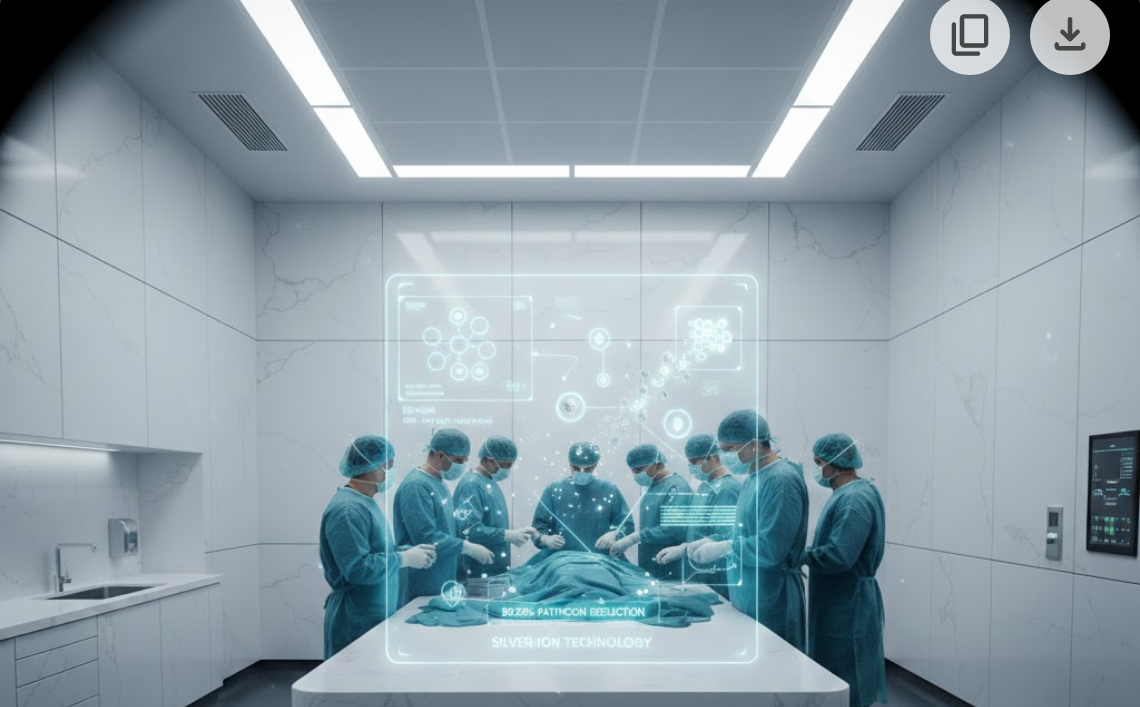
In 2026, the architectural philosophy of healthcare has shifted from reactive treatment to proactive environmental safety. The “Surface-to-Patient” transmission of pathogens—responsible for a significant percentage of Hospital-Acquired Infections (HAIs)—is now a primary focus for hospital administrators worldwide. As pathogens evolve, the materials we choose for high-traffic clinical environments must evolve with them.
Traditional surfaces, once the industry standard, are now under scrutiny. Laminate, while cost-effective, features inevitable seams and porous edges where bacteria and moisture thrive. Stainless steel, though hygienic, is prone to microscopic “pitting” and denting over time, creating recesses that evade standard cleaning protocols and degrade the facility’s aesthetic over a 20-year lifecycle.
1. The Science of “Active” Protection: Beyond Passive Hygiene
Modern anti-bacterial quartz is not merely a treated surface; it is an integrated clinical technology. In 2026, the standard for medical-grade quartz requires the antimicrobial agent to be a structural component of the material, ensuring protection that cannot be washed away or worn down.
Integrated Silver-Ion Technology
During the manufacturing process, silver ions are dispersed uniformly throughout the quartz and resin matrix. Unlike a topical coating, this 360-degree integration ensures that even if the slab is scratched or chipped, the antimicrobial properties remain active.
-
Mechanism of Action: Silver ions (Ag+) act as a multi-modal chemical attack on microbes. They bind to the thiol groups in bacterial enzymes, disrupting cellular metabolism and respiratory functions. Furthermore, they penetrate the cell wall to interact with DNA, effectively blocking replication and protein synthesis.
-
Efficacy: This technology has been proven to reduce microbial counts by up to 99.99% within 24 hours. It is highly effective against a broad spectrum of antibiotic-resistant bacteria, including MRSA, VRE, and E. coli.
Advanced Chemical and Stress Resistance
Hospital surfaces endure a chemical assault that would destroy residential-grade materials. To meet 2026 clinical standards, high-quality quartz undergoes rigorous Environmental Stress Crack Resistance (ESCR) testing.
-
Disinfectant Compatibility: Quartz Trader’s medical-grade slabs are tested against high-concentration Sodium Hypochlorite (Bleach), Betadine, Hydrogen Peroxide, and Isopropanol.
-
Integrity: The material is engineered to resist “crazing” or swelling when exposed to these chemicals under the mechanical stress of a busy ward, ensuring the surface doesn’t etch or lose its protective seal over decades of use.
2. High-Performance Application Zones
The deployment of anti-bacterial quartz is strategic, targeting the areas of highest risk for cross-contamination.
Operating Theaters and Sterile Suites
In the modern “Clean Room” environment, 1.2cm quartz sheets are used for full-height wall cladding.
-
The Seamless Mandate: By utilizing thermoformed corners and epoxy-welded joints, quartz creates a continuous, vertical surface that eliminates the grout lines of traditional tiles. This prevents the accumulation of aerosolized pathogens during surgical procedures.
-
Light Neutrality: Unlike reflective stainless steel, quartz can be specified in matte or satin finishes to reduce glare for surgeons while maintaining total non-porosity.
Nurse Stations and Reception Hubs
Nurse stations are the high-traffic “nerve centers” of the hospital, subjected to constant contact with medical equipment, wheelchairs, and patient beds.
-
Impact Resistance: With a Mohs hardness of 7, quartz is virtually immune to the deep scratches that harbor bacteria.
-
Aesthetic Longevity: These areas are often the first thing a patient sees. Quartz maintains a professional, “day-one” appearance for over 20 years, resisting the “run-down” look that can diminish patient confidence in a facility’s cleanliness.
Patient Bathrooms and Clinical Sinks
The joint between a sink and a countertop is the #1 breeding ground for mold and biofilm in healthcare settings.
-
Monolithic Construction: In 2026, the trend is toward integrated quartz sinks. These are fabricated as a single, one-piece unit with the countertop.
-
Biofilm Prevention: By eliminating the silicone seal and the “under-mount” lip, you remove the physical space where moisture and organic matter collect, drastically reducing the risk of fungal growth in patient-facing areas.
3. Lifecycle Cost and Operational Resilience
While the initial investment in medical-grade quartz is higher than laminate, the Total Cost of Ownership (TCO) is significantly lower.
-
Zero Sealing Required: Unlike natural stone, quartz is inherently non-porous. It never requires the periodic resealing that adds to a facility’s maintenance labor and chemical budget.
-
Durability vs. Replacement: A typical hospital renovation occurs every 15-20 years. Quartz is one of the few materials that can survive two full renovation cycles without needing replacement, providing a massive sustainability and financial benefit to the healthcare trust or provider.
➡️ Visit [www.quartztrader.com] and submit a project inquiry, or connect with us directly to discuss your material needs.
Quartz Trader, is a UK based company with a US office which specializes in the importation of quality Quartz slabs from throughout the world to Canada 🇨🇦, USA 🇺🇸, UK 🇬🇧 and Ireland 🇮🇪.
Speak to our team about your Quartz Slabs requirements by contacting us.
#QuartzSurfaces #UKDesign #KitchenDesign #BathroomRenovation #CommercialInteriors #ConstructionIreland #HomeRenovation #InteriorDesign #SustainableBuilding #quartztrader